Paris
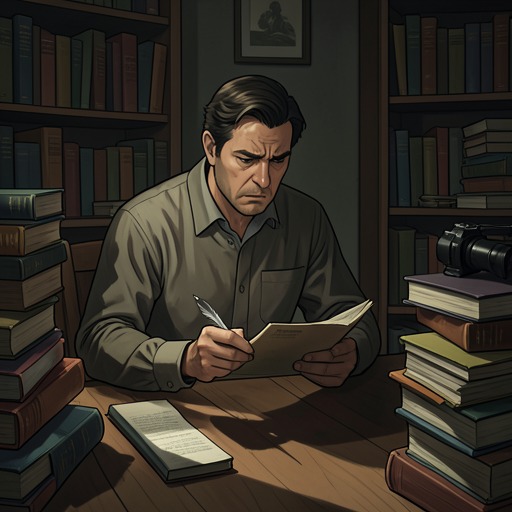
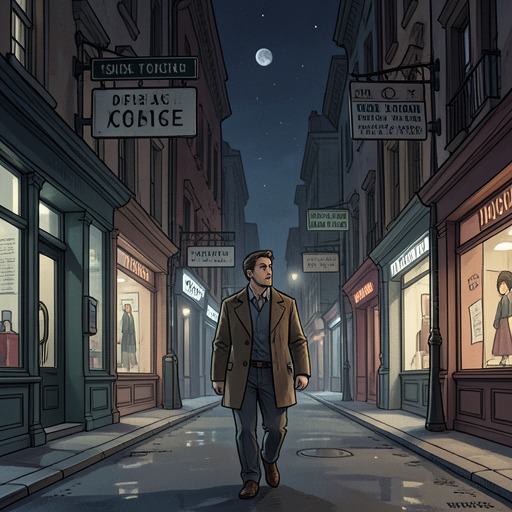
Foucault's PendulumParis is the setting in which the novel’s occult conjectures acquire their most dangerous physical form. The city contains the Conservatoire, where Casaubon hides while waiting for the expected midnight encounter, but it also becomes the geography through which he tries to escape, test, and finally narrate what he believes has happened. Its streets and monuments are at once real places and surfaces on which his interpretation of the Plan projects an all-encompassing design.
The Conservatoire and the Pendulum
Casaubon’s decisive Parisian setting is the Conservatoire des Arts et Métiers, entered through an eighteenth-century courtyard and housed in a former abbey church that had belonged to a priory. The building joins sacred architecture to the machinery of industrial and technological history. Vehicles line the nave, aircraft hang overhead, and corroded machines occupy the space around the choir. The exhibits seem to Casaubon less like a neutral celebration of progress than like participants in an unresolved dialogue. He distrusts the museum’s official account of its educational purpose, connecting its language to Francis Bacon’s description of Solomon’s House in New Atlantis and suspecting that the museum conceals a more arcane design.
At the center of the choir hangs the Pendulum: a copper sphere suspended from a long wire, swinging with measured regularity. Casaubon recognizes that its period depends on the wire’s length and on pi, and he imagines the motion as a convergence of mathematical relations—the point of suspension, the two dimensions of a plane, the circle, and the square root. The pendulum’s apparent mystery does not cancel its physical explanation. A magnetic device beneath it drives a cylinder inside the sphere, while the idealized principle of frictionless motion accounts for the imagined persistence of oscillation. Paris thus gives Casaubon a material mechanism that can be contemplated both as a scientific instrument and as a cosmic emblem.
The museum’s other objects become part of the same interpretive field. Mechanical remains in the choir seem like a cemetery whose parts might start moving again; the suspended aircraft resemble prehistoric creatures or threatening messengers. In the hall of glass, Casaubon encounters a three-dimensional lion attacked by a serpent and connects the image to Yaldabaoth, the first Archon in the cosmology of Sophia. Instead of treating the exhibits as unrelated collections, he reads the museum as a sequence that might enact cosmic decline, from the Pendulum and the fullness of the first principle toward a world ruled by evil. This is not established as an objective secret of the building: it is the pattern Casaubon constructs as he searches for confirmation.
Hiding, Watching, and Reading the City
Casaubon decides that he must remain in the Conservatoire after closing, believing that leaving would make it impossible to return by whatever hidden route he imagines the conspirators might use. He chooses the crowded nave as a place to hide, reasoning that a living person concealed inside a lifeless vehicle might escape the guards’ rounds. Later, in the hall of glass, he discovers a primitive periscope assembled from packing cases and lenses. Its projected image turns the outside into a dim, inverted scene, and Casaubon understands that it gives him a view as if from a high window in the apse, suspended above the city like the Pendulum itself.
Through the periscope he identifies rue Vaucanson, rue Conte, and the streets branching from it, along with two bars and the sign for LES CREATIONS JACSAM. The device supplies a genuine view, but its placement beside the lion-and-serpent sculpture encourages him to ask why this particular scientific contrivance is situated in this particular room. The scene condenses the novel’s tension between observation and inference: Casaubon can name the streets he sees, yet he treats their arrangement and the museum’s objects as possible signs of a hidden message. Paris becomes both a city that can be mapped and a code he feels compelled to decipher.
That compulsion is reinforced by the message sent to Belbo. A caller threatens to expose him as the unidentified occupant of seat number 45 unless he cooperates and reveals the Templars’ map. He is directed to meet a familiar bearded gentleman at Librairie Sloane, 3 rue de la Manticore, at noon on Wednesday, June 20, with the larger arrangement to reach its conclusion around the summer solstice. The Paris address is presented as a practical rendezvous, but within the developing plot it also draws Belbo toward the city and the conspirators’ promised gathering.
The City as Escape and Trap
After reading Belbo’s confessions, Casaubon concludes that whatever is going to happen will happen that night at the Conservatoire. On June 23, he weighs the evidence against the possibility that the papers describe the delusions of a group of madmen. His later recollection emphasizes that, at the time, curiosity and perhaps duty and friendship overcame fear. The contrast matters: Paris is not simply a setting Casaubon enters after forming a settled conviction. His decision to go there is one of the acts through which uncertain interpretation becomes commitment.
Once inside the Conservatoire, Casaubon escapes through an opening beneath the statue of Gramme. A narrow ladder and spiral stone stairway lead him into a sewer, where he follows the largest conduit away from the museum. The Paris sewers, previously imagined as a possible secret passage linking the building with another point in the city, become an actual route of flight. Their foul, subterranean passage offers him relief from the museum, which he describes in contrast as a kingdom of darkness. He carries away the image traced in the choir by Belbo’s corpse, unable to identify its meaning. Later, after finding a letter among Belbo’s notes about how a pendulum would behave if a second weight were attached along its wire, Casaubon recognizes that Belbo had imagined the Pendulum as both Sinai and Calvary. Belbo’s death, in this later understanding, was not merely the outcome of a recently devised Plan: his imagination had long prepared a symbolic setting for it.
The streets beyond the museum do not restore Casaubon to certainty. Near Porte Saint-Martin, he encounters young people arriving for a march against the Savary law and refuses an invitation into a club, interpreting the encounter through his fear of Alamut and hidden affiliations. A few blocks away he finds solitude again, then passes the Conservatoire, whose peaceful exterior gives no visible account of what may have happened inside. He wants to ask someone what has occurred, but cannot settle on a destination. Paris offers a succession of real, distinct neighborhoods and encounters; Casaubon experiences them as unstable points in a dangerous system.
Panic, Political Disorder, and Aftermath
Casaubon searches for Dr. Wagner, hoping the doctor will tell him that he is raving, that he has given substance to ghosts, and that Belbo is alive. He takes a taxi to Avenue Élisée-Reclus, but the address fails to provide the reassurance he seeks. He remembers Reclus as a writer on the earth and the underground whose geographical work, in Casaubon’s view, placed him among the people implicated in the Plan. The name therefore turns the attempted refuge into another sign of encirclement: Casaubon believes he is fleeing the conspirators while repeatedly finding them in the city’s geography. He also recognizes that what he needs may not be a psychoanalyst but sleep or Lia’s comfort.
The next day, Paris is absorbed in public unrest. Metro stations are closed, crowds fill the Latin Quarter, police barricades block the Île de la Cité, and distant shots and tear gas accompany the movement of students and police. Casaubon takes shelter with older bourgeois bystanders and feels shame as he waits for the confrontation to subside. When he reaches the Conservatoire again, the building is open to Sunday visitors and appears unchanged: guards, visitors, and the Pendulum are in their usual places. He finds no trace of the previous night’s events, if they happened at all. The ordinary museum and the city’s extraordinary disorder coexist without resolving his doubt.
At Dr. Wagner’s office, Casaubon finally speaks at length. The modest room overlooks the Seine, with the Tower visible in shadow; Wagner receives him as a patient, listens without interruption, and gives him the floor. Casaubon recounts his changing beliefs across two years, what he thinks Belbo and Diotallevi thought, and above all what happened on Saint John’s Eve. Paris therefore frames both the crisis and its attempted retelling: the city is the place where Casaubon enters the Plan’s imagined center, escapes it through the sewers, and later submits his account to another listener without receiving an immediate, definitive confirmation of what was real.